
I started reading Regencies in High School when I fell in love with Sense & Sensibility (the Emma Thompson & Kate Winslet version). I read Jane Austen's Sense & Sensibility, Pride & Prejudice, Emma, and Northanger Abbey shortly after. Around my junior year, I also discovered Amanda Quick and devoured as many of her Regency romances as I could find.
One of the things I like about writing Regency and watching the lovely Austen-based films is the clothing. There was a move away from the elaborate, flamboyant excess of the 18th century toward simplicity and cleanliness. Gone were the brightly colored jacquard and damask silks and heavy powders and perfumes (to cover up the fact that no one bathed).
It was under the influence of Beau Brummel that simple, elegant men's suits became popular. Women moved away from the rigid structure and large dresses of the 17th and 18th centuries. The silhouette was softer and--comparatively speaking--the dresses were barely there.
But what went over and under the thin muslin gowns that were popular during this period?
GLOSSARY OF REGENCY DRESS (WOMEN)
(This is in order of being worn rather than alphabetical order.) *Note that all images link back to their original source.
Chemise - This was a basic white linen or cotton shift on top of which everything else was worn. (Think of the most basic short sleeved pull over white nightgown with no buttons)
Stays - Stays are basically a corset, but many times would be shorter than a traditional corset. I've seen some long ones and I've seen super short ones that are sort of like a bra. Essentially, the Regency version of a corset was designed to push up the breasts and flatten the front.

This image from Sense & Sensibility patterns shows a chemise and the short stays.
Busk - The busk is a little piece of wood that you stick down the front of your stays which helps keep the front of your dress straight under the bust. Obviously, you'd only have a busk if you wore longer stays.

You can see from this picture that there is a long white space in the middle, which is where the busk would go.
Drawers & Pantalettes - Ladies drawers were considered very risque because they were made to look like men's pants/underwear. Technically they came to fashion in 1806, but not everyone wore them (I think they were more common in the later Regency). Drawers were basically two short leg coverings and were tied around the waist with strings, leaving the necessary bits open for ease of using the privy/chamberpot. Pantalettes were drawers that were more decorative and designed to be seen, in case a lady should lift her skirt or stretch out her legs. Some women wore drawers instead of a petticoat.
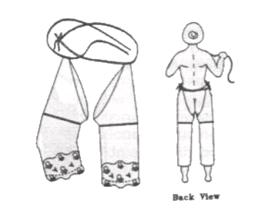
This is a basic set of drawers.
Petticoat - Over the stays/corset, a lady would wear a petticoat. The petticoat is a long, basic white skirt. However, the importance of a petticoat cannot be overstated. Regency women liked dresses made of thin cotton muslin, which shows pretty much everything. If there wasn't a petticoat (or drawers) under the chemise and dress, your favorite Regency lady would look like a prostitute.
Stockings - Stockings were often white and made of silk, wool, or cotton. They were short (think knee-highs) and were tied off with garters just below or just above the knee. Some women might embroider their stockings.
Gown/Dress - There are different dresses for different times of day and different activities. So insert the appropriate dress here. Dresses might be made of cotton/muslin, silk, satin or velvet. White was one of the most popular colors of the period, though there were also patterned dresses. Remember that the muslin of the Regency was a thin, loosely woven fabric (think of something like chiffon or a lose batiste or thin, sheer cotton lingerie). Many gowns were low cut and designed to emphasize the bust.
Fichu - This might be worn over or under a Regency lady's gown for cool weather or for modesty. It is a triangular piece of fabric that might be tucked into the gown or worn over it as a shawl. Some were simple and sheer and looked a lot like a handkerchief, while others were frilly and elaborate. Most of the ones I've seen were white cotton or lace, but there are examples of printed fabrics and knitted fichus.

In this example, an 18th century lady has a fichu tucked into her dress.
Spencer - This a short jacket worn over a dress, usually made of a thicker material such as velvet or wool. It basically covers the bust and arms.

Here Elizabeth Bennet (played by Jennifer Ehle) is wearing a basic spencer as she walks with the dashing Mr. Wickham.
Pelisse - This was a long, fitted (in most cases) outer garment that was worn over a dress. Originally, it was a fur lined coat or cloak, but in the Regency, it might also be a thick silk long jacket that could be worn at a party. In the winter, this would be a woman's version of a greatcoat and would be made of a heavy fabric, such as wool or velvet, and lined with fur. In the summer, it might be a silk coat or it might be an over-garment that was worn as part of the dress.

This pelisse from 1811 is lined with fur.

This is an example of an indoor pelisse that would be made of a lighter fabric.
Reticule - A reticule is a small purse. It might be a simple satin bag or it might be embroidered and decorated. Many examples have drawstrings.
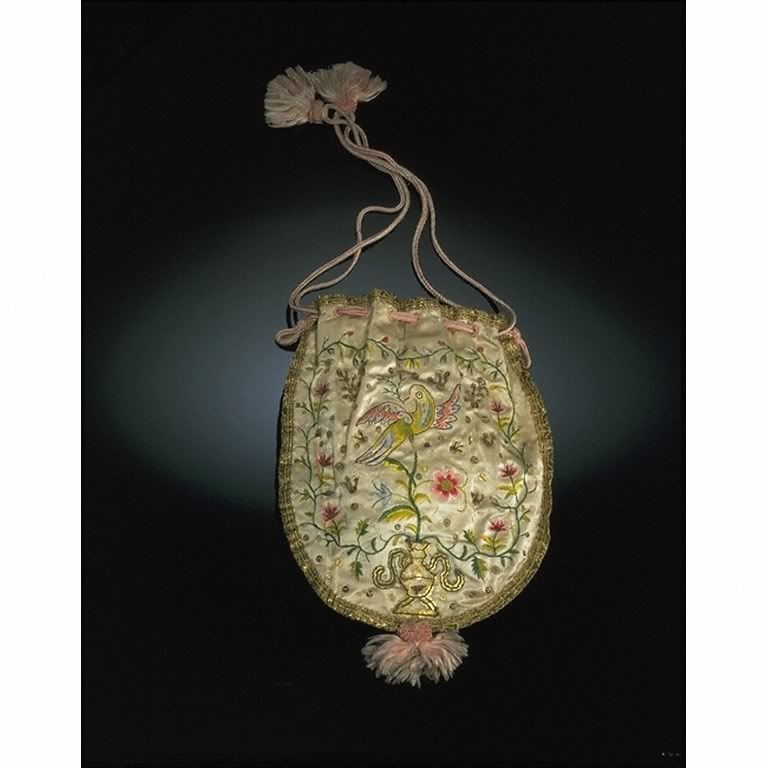
Here is an example of an embroidered reticule.
These are the basic items of a Regency lady's costume. I did not include cloaks (most of us know what a basic cloak looks like) and riding habits (which are special dresses designed for riding a horse). And of course, no lady's costume would be complete without hats, gloves, and shoes.
