L.G.C. Smith
This week marks the re-release of my first historical
romance, originally published by Avon Books in 1990. Now titled
The Outlaw’s Secret Bride, it’s available
as an ebook from
Amazon,
Barnes&Noble, and
Smashwords. TOSB,
a classic western romance set in the Black Hills of Dakota Territory in 1880, is
the story of an eastern schoolteacher who meets an outlaw she
can’t resist. She tries hard, but he doesn’t give up. I chose the setting
because my family is from South Dakota, and I made the heroine a teacher
because both sides of the family are chock full of South Dakota teachers. I had just started my doctoral
studies when I began writing
The Outlaw's Secret Bride (originally titled
Spellbound, and published under my pen name, Allison Hayes), so I wanted to be
practical. I figured writing about a place I knew fairly well would help me
manage the writing, the research it required, and a heavy course load.
Writing historical romance ended up shaping my academic work
in language education more than I anticipated. The tensions between the Lakota people
and the US government played out in many aspects of South Dakota history.
Education was a particularly fraught endeavor, illustrated in The Outlaw’s Secret Bride when the hero,
Drew, introduces Emily, the heroine, to Red Cloud, the famous Lakota leader.
Red Cloud astutely identified how disastrous the wrong sort of education could
be for his people. Thanks to the research for the novel, I began studying early
attempts to educate Lakota children. Red Cloud was right: the education brought
by white Americans relied heavily on coercion and the adamant rejection of
Lakota language, culture and values.
Occasionally educators, usually missionaries, developed
bilingual primers to help teach reading and writing to Native American
children. I discovered some of these buried in the University of California
library stacks and analyzed them for a research paper in the same year that
TOSB was first published. This is from a section looking at a little primer
called Model First Reader. Wayawa
Tokaheya. Prepared in English-Dakota by S.R. Riggs, an Episcopal missionary
to the Minnesota Sioux throughout most of the nineteenth century. It was
published in 1873 for use in western Minnesota. My interest lay in exploring
what Dakota and Lakota children might have been taught in schools using this
book. It serves as a back drop for understanding the kinds of conflicts my
teacher heroine encounters when she arrives in Dakota Territory and falls in
love with a man who has embraced the Lakota people.

“The content of the more
advanced lessons introduces domestic animals (dogs, cats, geese, sheep, lambs,
horses, and pigs) and several wild animals, including zebras, parrots, bears,
and deer. The animals are often pictured as pets in cages, houses, or playing
with children. These are not contexts in which Indian children would normally
have interacted with animals. Page 64 has a drawing of three children, Howard,
Della, and Gertrude riding in a miniature wagon drawn by two prancing goats. On
the previous page the goats were pictured in a mountain scene with tall pine
trees behind them. The message that even children can tame the wilds is not
subtly conveyed in the sentences that tell us that these goats will not run
away or hurt the children, that they are very gentle, and that they like
Howard. Howard, of course, is equally fond of the goats.
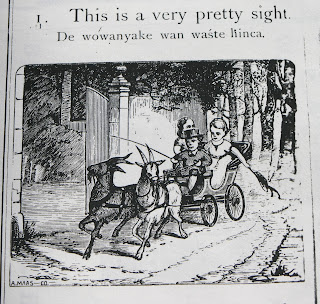
This sort of image may
have struck the fancy of American middle-class children, but it must have
seemed strange to Dakota children who very likely hadn’t ever seen goats, much
less miniature wagons for children to play in. More significantly, animals are
portrayed as playmates, means of entertainment, or as badges of membership in a
stable, well-ordered agricultural society. There is little of the sense of
respect for animals or an understanding of the roles they play in supporting
human life and sharing an environment that is more characteristic of Dakota
relationships with animals. It would not have been difficult to cast the
relationships of people to farm animals in this sort of light (and in fact,
many white farmers and ranchers probably held more Indian-like attitudes toward
their animals than one would guess from Victorian school texts). If the images
and values presented in this text were not directly related to the experience
of Dakota children, it must also be kept in mind that they would have found
little better match in the minds of large numbers of urban school children in
the rest of the country. The Model First
Reader taught an ideal, archetypical view of American culture based in
rural gentility.

An image of even more
cultural dissonance for Indian children than Howard and his sisters with their
pet goats appears a few pages later. On page 67 there is a drawing of a black
bear chained to a tall pole. The sentences are as follows:
1.
This is a black bear. De wahanksica heca.
(The normal gloss for bear is 'mato')
2. It is not a lamb. He tahinca cinca heca.
3. It looks ugly. He owanyang sica. ('Sica' means bad, not ugly
per se.)
4. He is chained to the pole. He can
kin en iyakaskapi.
5. Can he climb the pole? Can kin he adi okihi he.
6. Yes, he can climb to the top. Han, oinkpa hehanyan adi okihi.
7. I will not go near the bear. Wahanksica kin ikiyedan mde kte sni.
Aside from the alien
visual image of the chained bear, the words make it clear that the bear is to
be regarded as wild, potentially dangerous, and to be avoided by children. The
Dakota translation emphasizes that the bear is inherently bad and should be
handled accordingly. If it cannot be completely controlled, it must be avoided.
This is in marked
contrast to traditional Dakota perceptions of bears as the second member (the
other being humans) of the two-legged category of animals. Bears were thought
of as potential healers, teachers, and generally wise creatures. Dakota
children would have had to have been foolish not to have known that bears could
be dangerous (especially if unreasonably provoked by chaining them to a pole),
but they were taught a respect for animals, rooted in knowledge about their
behaviors, that is clearly lacking in this text. The image and the sentences
about the chained bear were very likely confusing for Dakota children because
they represented direct contradictions to traditional Dakota values.”
I have two nieces almost
finished with Kindergarten this year. Both are making great strides as
fledgling readers. It’s pretty easy for one of them, but not so much for the
other. I can’t imagine how hard it would be to learn to read from books that
had so little to do with their lives. A great teacher can work wonders with
almost any materials, but I wonder what the students who used these books
thought of them.
Reading is one of life’s
greatest pleasures for many of us. What were some of the first books you read
yourself? Were you one of the lucky people who just figured it out easily? (I
wasn’t.) Did you have a special teacher who helped you learn to read? Leave a
comment for a chance to win a copy of The Outlaw’s Secret Bride. I’ll draw a winner on Saturday, June 2nd
and post it here. Open to US and Canadian residents.
P.S. If you post a review
of
The Outlaw’s Secret Bride to any
of the ebook retailers, email me the link at
lgsmith@lgcsmith.com, and I’ll send you
a free copy of one of my other books.