Showing posts with label medieval romance. Show all posts

Tuesday, December 11, 2012

History of the Panama Canal by Anna Markland


Almost two years ago, my husband and I visited Panama on vacation. We didn’t do the Canal trip - in fact to this day we haven’t travelled along the Canal, though we have driven over and beside it.

During that first visit, we stumbled upon a sleepy little community called Las Lajas in Chiriqui province. About 10 km from there is the world’s best kept secret - an unbelievably beautiful beach. To cut a long story short, we decided to build a vacation condo there. We’ve been back several times since, and find the people and the country greatly to our liking. Gazing at the ocean and walking along an endless, deserted beach is very inspiring! 

One day I intend to pen a novel based in Panama, but on the last trip I spent most of my time putting the finishing touches to my latest medieval romance, Dance of Love. This story is set partially in Spain. Panama celebrated the anniversary of its independence from Spain on November 28th, so there is a bit of a connection!

Dance of Love is set in 1107 AD. It wasn’t until the Holy Roman Emperor, Charles V held sway in 1534 (400 years later) that we find the earliest mention of a canal across the Isthmus of Panama.

Charles V
Charles was also King of Spain, and he ordered a survey for a route through the Americas that would ease the voyage for ships traveling between Spain and Peru. Such a route would have given the Spanish a military advantage over the Portuguese. During an expedition from 1788 to 1793, Alessandro Malaspina outlined plans for its construction.
Alessandro Malaspina

Given the strategic location of Panama and the potential offered by its narrow isthmus separating two great oceans, other trade links in the area were attempted over the years. An ill-fated Darien scheme was launched by the Kingdom of Scotland in 1698 to set up an overland trade route, but generally inhospitable conditions thwarted the effort, and it was abandoned in July, 1699. To this day, the Darien jungle remains an inhospitable place.

In 1849, the discovery of gold in California created great interest in a crossing between the Atlantic and Pacific Oceans. Eventually, the Panama Railway was built to cross the isthmus, opening in 1855. This overland link became a vital piece of Western Hemisphere infrastructure, greatly facilitating trade and largely determining the later canal route.


An all-water route between the oceans was still seen as the ideal solution, and in 1855 William Kennish, a Manx-born engineer working for the United States government, surveyed the isthmus and issued a report on a route for a proposed Panama Canal. His report was published in a book entitled The Practicality and Importance of a Ship Canal to Connect the Atlantic and Pacific Oceans. Encouragement for the idea of a canal was provided by the French success in building the Suez Canal.


More to come...
If you would like to sample one of my books, If Love Dares Enough is available FREE for two days only on kindle. December 12th & 13th. 

Wednesday, November 14, 2012

Camino de Santiago de Compostela by Anna Markland


Modern day symbol of the Camino
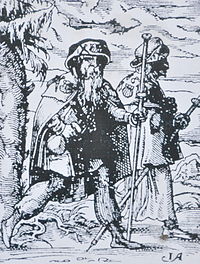
The Way of St. James has existed for over a thousand years. It was one of the most important Christian pilgrimages during medieval times. Legend holds that St. James's remains were carried by boat from Jerusalem to northern Spain where he was buried on the site of what is now the city of Santiago de Compostela.

The Way can take one of any number of pilgrimage routes to Santiago de Compostela. Traditionally, as with most pilgrimages, the Way of Saint James began at one's home and ended at the pilgrimage site. However a few of the routes are considered main ones. During the Middle Ages, the route was heavily travelled.

The scallop shell, often found on the shores in Galicia, has long been the symbol of the Camino de Santiago. Over the centuries the scallop shell has taken on mythical, metaphorical and practical meanings, even if its relevance may actually derive from the desire of pilgrims to take home a souvenir.

Two versions of the most common myth about the origin of the symbol concern the death of Saint James, who was beheaded in Jerusalem. James had spent some time preaching on the Iberian Peninsula.

Version 1: After James' death, his disciples shipped his body to the Iberian Peninsula to be buried in what is now Santiago. Off the coast of Spain a heavy storm hit the ship, and the body was lost to the ocean. After some time, however, the body washed ashore undamaged, covered in scallops.

Version 2: After James' death his body was mysteriously transported by a ship with no crew back to the Iberian Peninsula to be buried in what is now Santiago. As James' ship approached land, a wedding was taking place on the shore. The young groom was on horseback, and on seeing the ship approaching, his horse got spooked, and the horse and rider plunged into the sea. Through miraculous intervention, the horse and rider emerged from the water alive, covered in seashells.

The scallop shell also acts as a metaphor. The grooves in the shell, which come together at a single point, represent the various routes pilgrims traveled, eventually arriving at a single destination. The shell is also a metaphor for the pilgrim. As the waves of the ocean wash scallop shells up on the shores of Galicia, God's hand also guides the pilgrims to Santiago.

The scallop shell also served practical purposes for pilgrims on the Camino de Santiago. The shell was the right size for gathering water to drink or for eating out of as a makeshift bowl. It gave them privileges to sleep in churches and ask for free meals, but also warded off thieves who dared not attack devoted pilgrims.

The pilgrim's staff is a walking stick used by pilgrims. Generally, the stick has a hook on it so that something may be hung from it.

The earliest records of visits paid to the shrine dedicated to St. James at Santiago de Compostela date from the 8th century. The pilgrimage to the shrine became the most renowned medieval pilgrimage. The earliest recorded pilgrims from beyond the Pyrenees visited the shrine in the middle of the 10th century, but it seems that it was not until a century later that large numbers of pilgrims from abroad were regularly journeying there. The earliest records of pilgrims that arrived from England belong to the period between 1092 and 1105. However, by the early 12th century the pilgrimage had become a highly organized affair.
The daily needs of pilgrims on their way to and from Compostela were met by a series of hospitals and hospices. These had royal protection and were a lucrative source of revenue. Romanesque architecture, a new genre of ecclesiastical architecture, was designed with massive archways to cope with huge devout crowds. Pilgrims walked the Way of St. James, often for months, to arrive at the great church in the main square of Compostela and pay homage to St. James. So many pilgrims have laid their hands on the pillar just inside the doorway of the church that a groove has been worn in the stone.

The popular Spanish name for the astronomical Milky Way is El Camino de Santiago. According to a common medieval legend, the Milky Way was formed from the dust raised by travelling pilgrims. Compostela itself means "field of stars". Another origin for this popular name is Book IV of the Book of Saint James which relates how the saint appeared in a dream to Charlemagne, urging him to liberate his tomb from the Moors and showing him the direction to follow by the route of the Milky Way.

Today tens of thousands of Christian pilgrims and many other travellers set out each year to make their way to Santiago de Compostela. Most travel by foot, some by bicycle, and a few travel as some of their medieval counterparts did, on horseback or by donkey.

Four pilgrimage routes originate in France, then a well-defined route crosses northern Spain. Pilgrims on the Way of St. James walk for weeks or months. They follow many routes, but the most popular route is the French Way (Camino Francés). The Spanish consider the Pyrenees a starting point. Common starting points along the French border are Saint-Jean-Pied-de-Port or Somport on the French side of the Pyrenees and Roncesvalles or Jaca on the Spanish side. (The distance from Roncesvalles to Santiago de Compostella through León is about 800 km.).

Another possibility is to do the Northern Route that was first used by the pilgrims in order to avoid travelling through the territories occupied by the Muslims in the Middle Ages. The greatest attraction is its landscape, as a large part of the route runs along the coastline against a backdrop of mountains and overlooking the Cantabrian Sea.

However, many pilgrims begin further afield, in one of the four French towns which are common and traditional starting points: Paris, Vézelay, Arles and Le Puy. Cluny, site of the celebrated medieval abbey, was another important rallying point for pilgrims.

In Spain, France and Portugal, pilgrim's hostels with beds in dormitories dot the common routes, providing overnight accommodation for pilgrims who hold a credencial. In Spain this type of accommodation is called a refugio or albergue, both of which are similar to youth hostels.

Modern day Pilgrims' Passport
Most modern day pilgrims carry a document called the credencial, purchased for a few euros from a Spanish tourist agency, a church on the route or from their church back home. The credencial is a pass which gives access to inexpensive, sometimes free, overnight accommodation in refugios along the trail. Also known as the "pilgrim's passport", the credencial is stamped with the official St. James stamp of each town or refugio at which the pilgrim has stayed. It provides walking pilgrims with a record of where they ate or slept, but also serves as proof to the Pilgrim's Office in Santiago that the journey is accomplished according to an official route. The credencial is available at refugios, tourist offices, some local parish houses, and outside Spain, through the national St. James organisation of that country. The stamped credencial is also necessary if the pilgrim wants to obtain a compostela, a certificate of completion of the pilgrimage.

The compostela is a certificate of accomplishment given to pilgrims on completing the Way. To earn the compostela one needs to walk a minimum of 100 km or cycle at least 200 km. The pilgrim passport is examined for stamps and dates. If a key stamp is missing, the compostela may be refused. The pilgrim can state whether the goal of his Camino was 'religious', 'religious and other' or just 'other'. In the case of 'other' a compostelate in Spanish is given asking for blessing of this heathen. In the cases of 'religious' or 'religious and other' a compostelate in Latin is given. The Pilgrim Office of Santiago awards more than 100,000 compostelas a year to pilgrims from over 100 countries.

A Pilgrim's Mass is held in the Cathedral of Santiago de Compostela each day at noon for pilgrims. Pilgrims who received the compostela the day before have their countries of origin and the starting point of their pilgrimage announced at the Mass.

In my latest release, Dance of Love, the hero and heroine are forced to embark on the pilgrimage to Santiago by King Alfonso of Aragon. The year is 1107. Here is an excerpt:

They rode in silence, side by side. Most of their fellow pilgrims were on foot, and of peasant stock, yet they were everywhere greeted with respect and wished Good Journey more times and in more languages than they could count. There were few women among them. It was plain to see many were ill.

While Alfonso’s guide made sure Izzy and Farah were provided with sleeping accommodations that befitted their rank, he suspected most of the pilgrims slept on communal straw mattresses, trying to share warmth, willing to endure the inevitable lice that abounded in such close conditions. Izzy shivered, revolted by the thought of his beloved Farah being subjected to such deprivations.

His anger at Alfonso rose anew in his throat. Farah was too quiet. The journey was taking a great deal out of her and he worried about her health, recalling how ill she had become after the journey across the Perinés. Compostela was still a long way away.

At least they had the means to pay for good food, which he suspected most of the pilgrims did not. Many of them probably drifted off to sleep with less than a full stomach. Food and lodging was supposed to be free for pilgrims, but even well intentioned ecclesiastical orders had a limited ability to provide meals.

Izzy had experienced firsthand the dangers from bandits along the Camino. Peasant pilgrims had no protection from such hazards or from unscrupulous ferrymen, toll collectors and money changers. The so-called safe conduct pass did little to protect them from bad elements.

Potable water was a constant problem and most pilgrims had only shoes, some of them sturdy, some not, a cloak, a staff, a gourd for water, a leather bag, and a wide-brimmed hat. Every one proudly sported the ubiquitous symbol of the pilgrimage, a small scallop shell, around their necks. Izzy refused to wear the token, though Farah wore one tucked into her bodice. She put her hand over it in silent prayer when she thought he was not watching.

Izzy marvelled at the resilience of these folk. Travelling the camino on horseback was tiring enough. They had obvious faith in the gruelling pilgrimage to the far flung reaches of Spain. Many of them would be away from family, friends, and loved ones for at least a year, if they made it back at all.

He wondered somewhat sarcastically how many of them helped their ailing fellow pilgrims after hearing the dire warning of the Miracle of the Thirty Pilgrims. The supposed miracle had taken place more than a score and ten years earlier, but it was still the most talked about event. No man wanted to incur the wrath of Saint James by foreswearing their promise to help other pilgrims.

Wednesday, October 10, 2012

Little Known Medieval Dog Breed by Anna Markland


Some of the most popular posts on my own blog have been about the dog breeds I have featured in several of my medieval romances. The "star" of my latest release, Wild Viking Princess, is Thor, an alaunt gentil.

The following information about the breed comes from the webpage of the British Alaunt Society.

The Alaunt was bred and formed by the Alani tribes, Kavkaz nomads of Indo-Iranian ancestry, who were known as superb warriors, herdsmen and breeders of horses and dogs. The Alans bred their dogs for work and had developed different strains within the breed for specific duties. The Alaunt's primary ancestors are the dogs of the Caucasus and Central Asia, but also the shorthaired hounds of India and Persia. The large, massive guard dogs were not much different than the typical Eastern mountain dogs, even though the hunting variety was leaner and had a smoother and shorter coat.

When the Huns conquered the Alani tribes, the nation was separated in the 370's into the Eastern and Western Alans. The Eastern Alani tribes merged with the Albanians, Ossetians, Serbs and other nations, introducing their dogs into the bloodlines of many Balkan breeds, such as the Illyrian Mountain Dog, Metchkar, Qen Ghedje, Hellenikos Poimenikos and other Molossers of the region. Some believe that the white-coloured alaunts were the direct ancestors of Greek and Albanian breeds, which in turn influenced all other white dogs in the Balkans.

The Western Alans joined the Vandals on their raids through Europe and by the 410's, their fierce dogs were influencing many breeds in France, Spain, Portugal, England and other countries, spreading the use of the "alaunt" name, which became synonymous with the type of a working dog, rather than a specific breed.

Through breeding with various scenthounds and sighthounds, the alaunt became a valued large game hunting dog, existing in a variety of types, dictated by regional preferences.

In France, alaunts were separated into three main categories, based on physical appearance and the duties they performed. The lightest type was the Alaunt Gentil, a greyhound-like dog, which eventually became assimilated into the local hunting breeds with the Alaunt Veantre.

The heavier mastiff variety, known as the Alaunt de Boucherie, was crucial is the development of the fighting and baiting dogs of France. The same occurrences happened in other countries, such as England and Spain, where the alaunts gave birth to mastiffs and bulldogs, which in return influenced nearly every European guarding, baiting and fighting breed. By definition the Alaunt was “fleet enough to hold a wounded deer, brave enough to hold a wild boar and easily able to dispatch a wolf and also a fierce guard”.

This dog's name is actually Lynx
The British Alaunt Society has an interesting article by D.B.Plummer on the efforts to create a new breed, the New Alaunt, a functional replica of the medieval breed.   

Wild Viking Princess is available from Amazon for $1.99 for a limited time. The dog in the story belongs to the heroine, Ragna FitzRam, and was given to her by her Norman uncle as a puppy. The dog accompanies her on a journey from England to Hamburg. However, a fierce storm blows her ship off course and she ends up on an island on the west coast of Denmark.

Ragna is an Englishwoman who has named her dog Thor, because her family has always teased her with the nickname Wild Viking Princess. Of all the people in her family she most exhibits the characteristics of their Danish ancestors. She is rescued from the shipwreck by Reider, a true Viking. Don't worry, he saves the dog too! 
       

Tuesday, September 11, 2012

Norse Burial Customs by Anna Markland


The burial customs of Viking Age North Germanic Norsemen (early medieval Scandinavians), are known both from archaeology and from historical accounts such as the Icelandic sagas, Old Norse poetry, and notably from the account of Ahmad ibn Fadlan.

I have woven many of these rituals into the narrative of my latest release, Wild Viking Princess.
Throughout Scandinavia, there are many remaining tumuli in honour of Viking kings and chieftains, in addition to runestones and other memorials. Some of the most notable of them are at the Borre mound cemetery, in Norway, at Birka in Sweden and Lindholm Høje and Jelling in Denmark.


A prominent tradition is that of the ship burial, where the deceased was laid in a boat, or a stone ship, and given grave offerings in accordance with his earthly status and profession, sometimes including sacrificed slaves. Afterwards, piles of stone and soil were usually laid on top of the remains in order to create a tumulus.


It was common to leave gifts with the deceased. Both men and women received grave goods, even if the corpse was to be burnt on a pyre. A Norseman could also be buried with a loved one or house thrall, who was buried alive with the person, or in a funeral pyre. The amount and the value of the goods depended on which social group the dead person came from. It was important to bury the dead in the right way so that he could join the afterlife with the same social standing that he had had in life, and to avoid becoming a homeless soul that wandered eternally.

The usual grave for a thrall was probably not much more than a hole in the ground. He was probably buried in such a way as to ensure both that he did not return to haunt his masters and that he could be of use to his masters after they died. Slaves were sometimes sacrificed to be useful in the next life. A free man was usually given weapons and equipment for riding. An artisan, such as a blacksmith, could receive his entire set of tools. Women were provided with their jewelry and often with tools for female and household activities. The most sumptuous Viking funeral discovered so far is the Oseberg ship burial, which was for a woman (probably a queen or a priestess) who lived in the 9th century.

A Viking funeral could be a considerable expense, but the barrow and the grave goods were not considered to have been wasted. In addition to representing homage to the deceased, the barrow remained as a monument to the social position of the descendants. Especially powerful Norse clans could demonstrate their position through monumental grave fields.

Jelling, in Denmark, is the largest royal memorial from the Viking Age and it was made by Harald Bluetooth in memory of his parents Gorm and Tyra, and in honour of himself.

I loved the name Gorm as soon as I came across it, but I used it for the villain of my story (apologies to the real Gorm)!

Despite the warlike customs of the Vikings, there was an element of fear surrounding death and what belonged to it. If the deceased was not buried and provided for properly, he might not find peace in the afterlife. The dead person could then visit the bereaved as a revenant or draugr.

A 10th century Arab Muslim writer named Ahmad ibn Fadlan produced a description of a funeral of a Scandinavian, probably Swedish, chieftain who was on an expedition on the eastern route. The account is a unique source on the ceremonies surrounding the Viking funeral of a chieftain. Antonio Banderas played Ahmad in the fictional film, The 13th Warrior.


The dead chieftain was put in a temporary grave which was covered for ten days until they had sewn new clothes for him. One of his thrall women volunteered to join him in the afterlife and she was guarded day and night, being given a great amount of intoxicating drinks while she sang happily. When the time had arrived for cremation, they pulled his longship ashore and put it on a platform of wood, and they made a bed for the dead chieftain on the ship. Thereafter, an old woman referred to as the "Angel of Death" put cushions on the bed. She was responsible for the ritual.

Then they disinterred the chieftain and gave him new clothes. In his grave, he received intoxicating drinks, fruits and a stringed instrument. The chieftain was put into his bed with all his weapons and grave offerings around him. Then they had two horses run themselves sweaty, cut them to pieces, and threw the meat into the ship. Finally, they sacrificed a hen and a cock.
Meanwhile, the thrall girl went from one tent to the other and had sexual intercourse with the men. Every man told her "tell your master that I did this because of my love to him". While in the afternoon, they moved the thrall girl to something that looked like a door frame, where she was lifted on the palms of the men three times. Every time, the girl told of what she saw. The first time, she saw her father and mother, the second time, she saw all her relatives, and the third time she saw her master in the afterworld. There, it was green and beautiful and together with him, she saw men and young boys. She saw that her master beckoned for her. By using intoxicating drinks, they thought to put the thrall girl in an ecstatic trance that made her psychic and through the symbolic action with the door frame, she would then see into the realm of the dead. The same ritual also appears in the Icelandic short story Völsa þáttr where two pagan Norwegian men lift the lady of the household over a door frame to help her look into the otherworld.

Thereafter, the thrall girl was taken away to the ship. She removed her bracelets and gave them to the old woman. Thereafter she removed her finger rings and gave them to the old woman's daughters, who had guarded her. Then they took her aboard the ship, but they did not allow her to enter the tent where the dead chieftain lay. The girl received several vessels of intoxicating drinks and she sang and bade her friends farewell.

Then the girl was pulled into the tent and the men started to beat on the shields so her screams could not be heard. Six men entered into the tent to have intercourse with the girl, after which they put her onto her master's bed. Two men grabbed her hands, and two men her wrists. The angel of death put a rope around her neck and while two men pulled the rope, the old woman stabbed the girl between her ribs with a knife. Thereafter, the relatives of the dead chieftain arrived with a burning torch and set the ship aflame. It is said that the fire facilitates the voyage to the realm of the dead.

Afterwards, a round barrow was built over the ashes and in the centre of the mound they erected a staff of birch wood, where they carved the names of the dead chieftain and his king. Then they departed in their ships.

Thralls could be sacrificed during a funeral so that they could serve their master in the next world.The sexual rites with the slave girl show that she was considered to be a vessel for the transmission of life force to the deceased chieftain.

On the seventh day after the person had died, people celebrated the sjaund, or the funeral ale that the feast also was called since it involved a ritual drinking. The funeral ale was a way of socially demarcating the case of death. It was only after the funeral ale that the heirs could rightfully claim their inheritance.
Drinking Scene


I have tried to follow the spirit of these rituals in Wild Viking Princess, though by my time period (1124A.D.) the advent of Christianity had led to some of them being less gruesome. My hero (Reider Torfinnsen) and heroine (Ragna FitzRam) come from two different cultures, and these traditional rituals prove to be a stumbling block to the relationship between them. Ragna has never been known for her tolerance of ideas she does not agree with!


Wild Viking Princess is Book III of the FitzRam Family Series and is available from Amazon for $1.99 

Wednesday, August 15, 2012

Medieval Titanic by Anna Markland

The year 1120 saw one of the most significant shipwrecks in English history; a tragedy that cost the lives of the flower of English nobility and would eventually plunge the nation into two decades of chaos and misrule – a period that has become known as The Anarchy. The heir to the throne of England and hundreds of scions of noble families perished when the White Ship, one of the most advanced vessels of the time, was lost with all hands. Its wreck and the potentially priceless cargo (in terms of historical and material value) it carried have never been located.

 
Following the Norman Conquest of 1066, England was ruled by the dukes of Normandy. As overlords of two lands divided by the English Channel, it was routine for the Norman kings of England to shuttle back and forth between their dominions as they sought to preserve their territories on the Continent and in Britain. (The ongoing conflict between the two brothers who were the King of England and the Duke of Normandy features in my novel Passion in the Blood

Henry I, known as Beauclerc
In 1120, Henry I, third of the Norman kings of England and youngest son of William the Conqueror, had been forced to travel to Normandy to confront the King of France, Louis VI. Accompanying him was his heir and only legitimate son, 17-year old William Adelin. ‘Adelin’ is a latter-day rendering of ‘Atheling’ (the Saxon term for king) – he was named William the Atheling to show how the royal houses of the Saxons and Normans were unified in his person.

Henry had successfully resolved his dispute with Louis, gaining recognition for his son as the de facto Duke of Normandy, and was returning to England via the Norman port of Barfleur. The mood of the party was festive, especially since young William was habitually accompanied by a kind of ‘youth court’ – a youthful mirror version of his father’s court, which included many of the most important heirs and offspring of the noble houses of England and Normandy. With the party were his own half-brother and sister – Henry I was the most prolific father of illegitimate children in the history of the English monarchy. Despite this, William was his only legitimate son (one of only two legitimate children), and was therefore absolutely central to Henry’s dynastic ambitions.

On 25 November Henry was preparing to embark at Barfleur when he was approached by Thomas FitzStephen, master of the Blanche Nef, or White Ship, a fine new vessel of the highest specifications. FitzStephen’s father Airard had captained the Mora, the flagship of William the Conqueror’s invasion fleet (more about this in my novel Conquering Passion), and now he himself begged William’s son for the honour of bearing him across the Channel in his splendid ship. Henry declined, as his own travel arrangements were already well in hand, but suggested that FitzStephen could carry his son, William Adelin, and his company. Henry boarded his own ship and departed not long afterwards, safely making the passage back to England.

Meanwhile William and his companions were feasting and drinking prodigiously, and their own departure was delayed while all the available casks of wine in port were loaded onto the White Ship. Once aboard, the partying continued, with the captain and crew apparently joining in. The company grew so inebriated that when a party of clerics led by the Bishop of Coutance arrived they were driven off with howls of derision. At least one of the passengers disembarked at this time: Stephen of Blois – possibly as a result of an attack of diarrhoea, or possibly because of an attack of common sense given the carryings on. It was a decision that would have fateful consequences.

By the time the White Ship was ready to depart everyone aboard was roaring drunk and night had fallen. On board were around 300 people, including 140 noblemen and at least 18 noblewomen. In relative terms, the Channel crossing was not especially dangerous – Henry had done it many times, while his father had made the crossing 17 times as king. But in the 12th century naval technology was still crude, and any sea journey was dangerous, particularly with a drunken crew, captain and pilot. To make matters worse, young William was keen to catch up with his father and get home first, and insisted that FitzStephen take the quickest route home.

This was to prove fatal. The correct route to take out of Barfleur harbour was to the south, avoiding dangerous shoals, after which the vessel would swing north towards England. The ship’s drunken pilot tried to cut corners by heading directly north, but succeeded only in driving the ship onto a rock called the Quilleboeuf, about 2.4 kilometres (1.5 miles) out of the harbour.

The ship began to sink, but all was not lost for William. He was quickly hustled aboard the only ‘lifeboat’, but as he was rowed to safety he heard the piteous cries of his half-sister, Matilda, Countess of Peche, imploring him not to abandon her. William ordered the boat to turn back, but as it neared the sinking ship it was overwhelmed by the number of people who tried to climb aboard and it too was lost.

This at least was the tale told by a butcher of Rouen named Berthold, who had only gone aboard to chase up a debt. He clung to one of the masts that projected above the waves, and was rescued the next morning. He was the sole survivor: few people of that era could swim, and in the dark, amidst the waves and strong currents, a watery grave was inevitable. When the news reached England none of the barons or high officers of the court dared to tell the king; it was left to a child to tell him the terrible tidings. It is said that he fainted away, and that he never smiled again.

The lost generation
The impact on the world of power politics in north-western Europe must have been tremendous, not to mention the personal toll on bereaved parents. The feeling that might have been prevalent is well captured by Winston Churchill in his account of the disaster in A History of the English Speaking People:
Two men remained afloat, the ship’s butcher and a knight. ‘Where is the Prince?’ asked the knight above the waves. ‘All are drowned,’ replied the butcher. ‘Then,’ said the knight, ‘all is lost for England,’ and threw up his hands [thereby casting himself into the waves].

The disaster has been likened to the sinking of the Titanic, which carried many rich and important people and had a colossal impact on Edwardian Britain. 

For 12th-century England the sinking of the White Ship was to have grim consequences. Despite his extra-marital fecundity, Henry was unable to produce another legitimate male heir. Although he forced his barons to swear allegiance to his legitimate daughter, also called Matilda, the idea of a female ruler simply would not wash with the medieval mindset. When Henry died in 1135 most of the English barons promptly ignored their oaths and acclaimed Stephen of Blois, Matilda’s cousin and the same man who had so fortuitously stepped off the White Ship before it sailed to disaster, as king. Matilda was able to rally some support and attempted to reclaim the crown, plunging the country into nearly 20 years of civil war. It was a lawless and unstable time, when, in the memorable words of the contemporary Peterborough Chronicle, ‘Crist and alle his sayntes slept.’

The White Ship disaster is an important event in the plot of SWEET TASTE OF LOVE, a novella I have written about the period. Two of my most beloved characters perish in the catastrophe, and the story is about the impact of that tragedy on their children. It's an intimate romance with a monk as the hero! Hmmm!
Available here for .99 cents

Wednesday, May 16, 2012

Anniversary of Canada's Titanic by Anna Markland


I have blogged about this tragedy before, but since the catastrophe of the Empress of Ireland occurred in the month of May 1914, I thought visitors who may not have heard the story before might be interested in reading about it.

On its 100th anniversary, the sinking of the Titanic continued to fascinate people around the world. But another shipwreck, almost equal in human tragedy, has slipped from popular memory, even though the vessel helped build modern Canada.

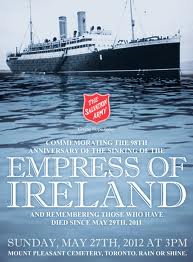
The Empress of Ireland sank in May 1914 in the St. Lawrence River after colliding with the Storstad, a Norwegian coal ship. A total of 1012 passengers and crew died, compared with the Titanic’s 1514.

The loss of the Empress of Ireland remains the largest maritime accident in Canadian history.

The Storstad After the Collision
Unlike the Titanic, which went down on its maiden voyage, the Empress of Ireland regularly plied the Atlantic Ocean. Between 1906 and her sinking, the Empress completed 95 round trips, mostly between Liverpool, England, and Halifax or Quebec City. She was one of two Canadian Pacific ships plying the Atlantic between the UK and Canada, bringing thousands of immigrants, most drawn by the prospect of free land on the Prairies.

For years, the remains of the Empress lay on the river bottom off Rimouski, Quebec, where it was picked over by souvenir hunting divers. It was designated a national historic site in 1988, but it wasn’t until 11 years later that the Quebec government tightened regulations to stop souvenir collecting. A small museum dedicated to the Empress now operates in Rimouski for half the year.

The Empress of Ireland played a huge role in forming modern Canada. It’s estimated approximately 500,000 Canadians are descendants of passengers who arrived on the ship. It is Canada’s Titanic.

The day before the tragic sinking, the Empress of Ireland had left Quebec City, bound for Liverpool. Sailing in fog, she was struck near Rimouski by the Storstad, which sliced an enormous gash in the starboard side of her hull. Water rushed in and the ship listed severely, allowing more water to rush in through open portholes. With the ship on its side, some survivors squeezed out of portholes on the opposite side of the ship. But most passengers were trapped inside and drowned. The ship sank in 14 minutes.

According to author Derek Grout in Empress of Ireland, The Story of an Edwardian Liner, those 14 minutes would make few people proud.

“There were no gentlemanly cries of ‘Women and children first!’ In the dark of night it was a free for all and surviving the sinking was a matter of luck at best.”

A board of inquiry would later blame the crew of the Storstad, but Norwegian authorities conducted their own investigation and disputed these findings. A Canadian documentary, The Last Voyage of the Empress, re-enacted the collision and concluded the fog was mostly to blame, but Empress Captain Henry Kendall was not without fault.

A salvage operation shortly after the collision recovered the ship’s mail and 212 bars of silver, worth about $1.1 million today.

Within months of the sinking, World War One was underway, and the thousands of men dying in the trenches every day soon overshadowed the casualties of the Empress of Ireland.

Some believe Canadian Pacific wanted to keep things quiet. With ships on the Atlantic, a railway and hotels spanning Canada, and more ships on the Pacific, it was possible to circumnavigate the globe without leaving the care of CP. The company was reluctant to air details of the sinking.

In 1971, David Brinnin, an American poet, literary critic and travel writer, dismissed the significance of the Empress of Ireland wreck. Brennin wrote that the dead were nothing better than “a lot of middle class Anglo-Saxons and a long roster of Salvation Army officers and executives from one end of Canada to the other.”

The Salvation Army was in fact devastated by the loss of many of its officers from Canada, and holds a memorial every year.

So in 1998, when maritime historian David Zeni published his book on the ship, he titled it The Forgotten Empress.

A few small tales have lived on. According to James Croall, writing in the 1978 book Fourteen Minutes, the ship’s cat, a yellow tabby “of doubtful antecedents”, fled down the gangway just as the ship was leaving. A steward ran after him and brought the cat back, but again the animal bolted and was left behind.

Efforts are underway to ensure that when the 100th anniversary of the sinking of the Empress of Ireland rolls around in 2014, Canadians will be more aware of this nationally important maritime disaster.

This story struck a small personal chord for me. Many years after this tragedy, I sailed to Canada as an immigrant aboard the CP’s Empress of England. We too left from Liverpool to Quebec City to begin a new life.

It also occurs to me this would be a great background story for a romance novel!

Anna Markland is the Canadian author of two medieval romance series, The Montbryce Legacy, and Sons of Rhodri. Book I of the Legacy, Conquering Passion, is still available for only 99 cents on Kindle.


Monday, May 7, 2012

The Good Medieval Wife

One of my favorite research books is The Good Wife's Guide: Le Menagier de Paris, A Medieval Household Book. This book was translated by Gina L. Greco and Christine M. Rose, but was originally written in the medieval era as a tool for wives.

I thought I would share with a few guidelines about being a good medieval wife... How do you add up?

  • Arise at daybreak and say your prayers. Take care with dressing and doing your hair so that no one will mock you.
  • When traveling to town or church, make sure you are suitably accompanied by your gentlewomen--and avoid the company of those that would be considered suspect. In other words, don't ride to town alone with a man who is not your husband, or even a woman with a bad reputation.
  • Attend mass daily and go to confession often. When you're at church--do not look at anyone or anything other than your prayer book and or Jesus.
  • Care for your husband's person. This means making sure he has clean linens, removing his shoes before a fire, making sure he has plenty of food and drink and be sure to lay out his clothes the following morning.
  • If your rooms are infested with flies, hang sprigs of ferns from the ceiling so they will settle there. To kill them mix milk and hare's gall bladder in a bowl, those pesky flies who drink it will perish.
  • Do not assume authority or command over your husband, else he fell you with one hand.
  • Keep your husbands secrets.
  • Remain chaste--or else... Some rather vulgar and scary stories to scare women from cheating... One in particular about a woman who was impaled through the groin on a post.
  • The book also teaches woman how to prepare menus, down to ordering meat from butcher shops and how it should be prepared and multiple dishes to serve and how to arrange them.
  • Do not abandon your heart to any of the Seven Deadly Sins: Wrath, Greed, Lust, Sloth, Pride, Envy and Gluttony. Instead, capitulate to Humility, Devoutness, Magnanimity, Contemplation, Fear of the Lord, Gentleness, Pity, Justice, Modesty and Equity.
Would you make a good medieval wife? In reality, if I were living during this time period, my answer would be NO. I'd probably be whipped daily, starved and a horde of other atrocious things because I am a total independent control freak, lol. But I am surprised to see that most of the guidelines are things women do now anyways, including myself. I arise at daybreak. I take care of my household. I avoid the Seven Sins. I'm a vegetarian so I avoid the meat market... but I do get fly traps if we ever get any during the summer, and I do keep my husbands secrets. 


I'd love to give away a signed copy of my medieval romance, A LADY'S CHARADE, to one lucky commenter (US & Canada only). Leave a comment to win! I will draw names on Friday.


From across a field of battle, English knight, Alexander, Lord Hardwyck, spots the object of his desire—and his conquest, Scottish traitor Lady Chloe. 

Her lies could be her undoing…

Abandoned across the border and disguised for her safety, Chloe realizes the man who besieged her home in Scotland has now become her savior in England. Her life in danger, she vows to keep her identity secret, lest she suffer his wrath, for he wants her dead. 

Or love could claim them both and unravel two countries in the process…

Alexander suspects Chloe is not who she says she is and has declared war on the angelic vixen who's laid claim to his heart. A fierce battle of the minds it will be, for once the truth is revealed they will both have to choose between love and duty.


Eliza Knight is the multi-published author of sizzling historical romance and erotic romance. Visit her at www.elizaknight.com or www.historyundressed.blogspot.com

Wednesday, April 11, 2012

The Bayeux Tapestry Comes to Life by Anna Markland

For any writer of medieval romance set at the time of the Norman Conquest of England, the Bayeux Tapestry is an invaluable resource. I studied it carefully while writing the first book of my series The Montbryce Legacy. In Conquering Passion, my hero, Rambaud (Ram) de Montbryce, is given the responsibility by William the Duke of Normandy of building the invasion fleet.

I found it incongruous that the launch of the fleet was held up for six weeks because of unfavourable winds. Surely if the Normans were descendents of the Viking Norsemen they would simply have rowed across the Channel. But no, a close examination of the tapestry clearly shows there were no oarsmen, only men holding the tillers and the wind filling the square sails.

One of the reasons the Normans were ultimately victorious is that they had mounted troops. While it may be difficult to believe that hundreds of horses were transported on these relativley crude longboats, that too is clearly shown in the tapestry.

The tapestry, which is actually an embroidery, was completed in England by Anglo-Saxon artists who were well known for their embroidery skills. It was sent to Bayeux where William the Conqueror's half brother, Eude (Odo) was building a cathedral. He was Bishop of Bayeux and had fought alongside William in the Battle of Hastings.

The tapestry details the reason for the invasion-Harold Godwinson's "stealing" of the throne of England after the death of Edward the Confessor.

My latest release, Defiant Passion, tells the story of the coming of the Normans from the Celtic viewpoint of the Welsh resistance to Norman rule. Many readers have suggested that the villain-turned-hero Rhodri from Conquering Passion is worthy of his own story. So I gave him his own series, entitled The Sons of Rhodri. Defiant Passion is Book One, and Dark and Bright (coming soon) will tell the story of Rhodri's oldest son, Rhys. Readers met Rhys briefly in A Man of Value.


The Conqueror's insistence on a record glorifying and justifying his invasion of England has left us with a tremendously rare glimpse into a medieval event that completely changed the course of history.
I hope you enjoy this nifty animated version of the Tapestry where history comes to life.


Quick reminder you can qualify to win a Kindle if you leave a comment. Plus a free download of Defiant Passion will be awarded to one lucky commenter on today's post.

Thursday, April 5, 2012

Tax Day and a Giveway

Tax day is fast approaching. I don’t know if this will interest folks as much as it did me, but I was surprised to learn even this little bit about the history of our federal income tax system. Taxes have been a hot topic from the inception of our country. We all know that our forefathers and those who fought alongside them believed we had to have representation: No taxation without representation. (The Colonists felt their interests weren’t being represented to the King.) Most of us also know our country didn’t begin with a federal tax. What I didn’t know was that we did have a federal tax for a short time, but it was abolished because it was deemed unconstitutional!

Take a look and let me know what you think.

History of the Income Tax in the United States
Source: Tax Foundation.

In 1862, in order to support the Civil War effort, Congress enacted the nation's first income tax law. It was a forerunner of our modern income tax in that it was based on the principles of graduated, or progressive, taxation and of withholding income at the source. During the Civil War, a person earning from $600 to $10,000 per year paid tax at the rate of 3%. Those with incomes of more than $10,000 paid taxes at a higher rate. Additional sales and excise taxes were added, and an “inheritance” tax also made its debut. In 1866, internal revenue collections reached their highest point in the nation's 90-year history—more than $310 million, an amount not reached again until 1911.

The Act of 1862 established the office of Commissioner of Internal Revenue. The Commissioner was given the power to assess, levy, and collect taxes, and the right to enforce the tax laws through seizure of property and income and through prosecution. The powers and authority remain very much the same today.

In 1868, Congress again focused its taxation efforts on tobacco and distilled spirits and eliminated the income tax in 1872. It had a short-lived revival in 1894 and 1895. In the latter year, the U.S. Supreme Court decided that the income tax was unconstitutional because it was not apportioned among the states in conformity with the Constitution.

In 1913, the 16th Amendment to the Constitution made the income tax a permanent fixture in the U.S. tax system. The amendment gave Congress legal authority to tax income and resulted in a revenue law that taxed incomes of both individuals and corporations. In fiscal year 1918, annual internal revenue collections for the first time passed the billion-dollar mark, rising to $5.4 billion by 1920. With the advent of World War II, employment increased, as did tax collections—to $7.3 billion. The withholding tax on wages was introduced in 1943 and was instrumental in increasing the number of taxpayers to 60 million and tax collections to $43 billion by 1945.

In 1981, Congress enacted the largest tax cut in U.S. history, approximately $750 billion over six years. The tax reduction, however, was partially offset by two tax acts, in 1982 and 1984, that attempted to raise approximately $265 billion.

On Oct. 22, 1986, President Reagan signed into law the Tax Reform Act of 1986, one of the most far-reaching reforms of the United States tax system since the adoption of the income tax. The top tax rate on individual income was lowered from 50% to 28%, the lowest it had been since 1916. Tax preferences were eliminated to make up most of the revenue. In an attempt to remain revenue neutral, the act called for a $120 billion increase in business taxation and a corresponding decrease in individual taxation over a five-year period.

Following what seemed to be a yearly tradition of new tax acts that began in 1986, the Revenue Reconciliation Act of 1990 was signed into law on Nov. 5, 1990. As with the '87, '88, and '89 acts, the 1990 act, while providing a number of substantive provisions, was small in comparison with the 1986 act. The emphasis of the 1990 act was increased taxes on the wealthy.

On Aug. 10, 1993, President Clinton signed the Revenue Reconciliation Act of 1993 into law. The act's purpose was to reduce by approximately $496 billion the federal deficit that would otherwise accumulate in fiscal years 1994 through 1998. In 1997, Clinton signed another tax act. The act, which cut taxes by $152 billion, included a cut in capital-gains tax for individuals, a $500 per child tax credit, and tax incentives for education.

President George W. Bush signed a series of tax cuts into law. The largest was the Economic Growth and Tax Relief Reconciliation Act of 2001. It was estimated to save taxpayers $1.3 trillion over ten years, making it the third largest tax cut since World War II. The Bush tax cut created a new lowest rate, 10% for the first several thousand dollars earned. It also established a slow schedule of incremental tax cuts that would eventually double the child tax credit from $500 to $1,000, adjust brackets so that middle-income couples owed the same tax as comparable singles, cut the top four tax rates (28% to 25%; 31% to 28%; 36% to 33%; and 39.6% to 35%).

The Jobs and Growth Tax Relief and Reconciliation Act of 2003 accelerated the tax rate cuts that had been enacted in 2001, and temporarily reduced the tax rate on capital gains and dividends to 15%. In 2004, the U.S. was forced to eliminate a corporate tax provision that had been ruled illegal by the World Trade Organization. Along with that tax hike, Congress passed a cornucopia of tax breaks, which for individuals included an option to deduct the payment of whichever state taxes were higher, sales or income taxes.

Two tax bills signed in 2005 and 2006 extended through 2010 the favorable rates on capital gains and dividends that had been enacted in 2003, raised the exemption levels for the Alternative Minimum Tax, and enacted new tax incentives designed to persuade individuals to save more for retirement.

Article Source

Everyone deserves a break during tax season. My contribution is a digital copy of my Scottish Medieval The Pendulum. Leave a comment and you're in the drawing. I'll contact the winner via email.

Link

Two men.

Two murderers.

Two demands for the promised payment of marriage.

Murder, deceit, and fraud pull Lady Arin Keith between these men.

Which one will bed her, claim her...own her?

WWW.TARAHSCOTT.COM

Wednesday, March 14, 2012

Why Medieval? by Anna Markland


Hello to everyone,
As this is my first post to the new blog, I thought I’d introduce myself and answer some questions readers have asked me.
Why did I choose to write medieval romance?  I am very interested in family tree research and over the course of the last few years I've written mostly family histories. Any fiction I wrote was contemporary, but I was working full time and didn’t think to publish any of it.

When I found myself with more time on my hands, I decided to take advantage of the changes sweeping the publishing industry and write novels.When I’m reading, my favourite genre is historical romance. Though I enjoy a good Regency, I’m more drawn to medieval.

In my genealogical pursuits I had done a great deal of research on the area of England where I was born. I stumbled across a story of a young noblewoman who had been exiled with her father. His crime was the blinding and mutilation of another baron during an argument over a piece of land.

On further investigation I learned that the woman turned out to be a very unpleasant person herself. But the seed was planted in my mind and I wondered what life would have been like for a young noblewoman cast out of her castle home and forced to wander with her irascible father. This was the initial beginning for Conquering Passion—except I made my heroine lovable!


I have traced my own family back to the late Middle Ages, but it has always been my ambition to go as far back as the Norman Conquest. So I decided to start my stories at that point in history!  I became completely immersed in the details of the Conquest. It amazed me how little I knew about the period even though it had such a profound influence on the history of England—land of my birth! My interest in ancestry and roots is what led me in the direction I’ve gone with my fiction writing. My stories follow the lives of the members of one family through successive generations.
My novels have also given me the opportunity to write about several of the Kings of England, from Harold Godwinson and William the Conqueror in Books One and Three, William Rufus in Book Two, and Henry I in Book Four.
For some strange reason known only to my subconscious mind, I didn’t write the books in chronological order! So if you prefer to read a series in that order you should read Book Three before Book Two!

I also tackle issues in my books which have resonance in our modern world. Books One and Three deal with post traumatic stress, and Book Four details the long term effects of solitary confinement. Book Two deals with the issues of illegitimacy and religious hatreds. It's difficult to write romance set in the Middle Ages without describing the pitiful rights women had.Their often dire plight at the hands of the men who held sway over their lives features in all my books.

The books in my Montbryce Legacy series have proven popular, and the first three are now available on Amazon in digital and paperback formats. Book One, Conquering Passion is the longest, and the most popular, but readers who’ve read it are then buying Books Two and Three, which is of course delightful. I’m glad they are as fond of the Montbryce family as I am. Readers have told me they are particularly taken with Hugh de Montbryce in If Love Dares Enough. He’s a virgin hero, and there aren’t too many of those in medieval romance!

I have just published the Kindle edition of the fourth book in my trilogy! Yes, The Montbryce Legacy is now an obsession! This book is entitled Passion in the Blood, and paperbacks will be available from Amazon.com in about three weeks. It’s the story of the two legitimate sons of Ram de Montbryce, the hero of Conquering Passion.

BTW, today (Mar. 14th) is the first day Passion in the Blood is FREE on Amazon-for a limited time

I’m also writing a novella to kick off another series, Sons of Rhodri. The Rebel Chieftain, will tell the story of Rhodri ap Owain, a Welsh rebel who first appears in Conquering Passion. Another project I’m working on is the creation of a downloadable Family Tree for the Montbryce Family.

I’m often asked how I came up with the titles of my books. Because my first book was about the Norman Conquest of England I wanted the title to reflect that. Also it’s a love story, so somehow, Conquering Passion evolved. I liked it because of the double entendre.

The title of Book Two was for a long time based on a quote from Shakespeare. But I had to change it from Kindle Fire With Snow—guess why? It’s now entitled A Man of Value, based on a quote from Einstein. It seemed appropriate because the hero is a man who discovers he is the epitome of everything he has always despised, and only love eventually leads him to see he is still a man of value.

If Love Dares Enough comes from a quote from Lord Byron. I chose it because the hero risks everything the family holds dear for the woman he loves.

Passion in the Blood came about because I wanted to continue the notion that the second generation has inherited “the Montbryce curse”—they are unlike most noblemen in that they are in love with the women they eventually marry!

In conclusion, I want to thank my readers for taking the Montbryce family to their hearts. Be reassured there will be lots more stories coming. As I mentioned, Rhodri ap Owain’s family has spawned a new series, Sons of Rhodri, and Caedmon FitzRambaud’s family will begin another one later this year. Caedmon’s daughter, Blythe FitzRambaud will be the first heroine in that series. Her adventures will take the readers to medieval Germany and introduce them to Heinrich, Holy Roman Emperor. This will be a bit of a departure for me because my stories to date have revolved around the lives and loves of the men of the family.

Readers are welcome to visit my Facebook Fan Page, Anna Markland Novels, and my website www.annamarkland.com, where they’ll find a link to my blog. I’m also a Goodreads author. My digital books are for sale in all the usual places, except Passion in the Blood which is exclusive to Amazon. Signed paperbacks can be ordered on my website, and you can enter to win one of 5 signed copies of A Man of Value on Goodreads until March 17th.

One lucky commenter on this blog will win a copy of any one of my books-yourchoice.