
I have blogged about this tragedy before, but since the catastrophe of the Empress of Ireland occurred in the month of May 1914, I thought visitors who may not have heard the story before might be interested in reading about it.
On its 100th anniversary, the sinking of the Titanic continued to fascinate people around the world. But another shipwreck, almost equal in human tragedy, has slipped from popular memory, even though the vessel helped build modern Canada.
The Empress of Ireland sank in May 1914 in the St. Lawrence River after colliding with the Storstad, a Norwegian coal ship. A total of 1012 passengers and crew died, compared with the Titanic’s 1514.
The loss of the Empress of Ireland remains the largest maritime accident in Canadian history.
 |
| The Storstad After the Collision |
Unlike the Titanic, which went down on its maiden voyage, the Empress of Ireland regularly plied the Atlantic Ocean. Between 1906 and her sinking, the Empress completed 95 round trips, mostly between Liverpool, England, and Halifax or Quebec City. She was one of two Canadian Pacific ships plying the Atlantic between the UK and Canada, bringing thousands of immigrants, most drawn by the prospect of free land on the Prairies.
For years, the remains of the Empress lay on the river bottom off Rimouski, Quebec, where it was picked over by souvenir hunting divers. It was designated a national historic site in 1988, but it wasn’t until 11 years later that the Quebec government tightened regulations to stop souvenir collecting. A small museum dedicated to the Empress now operates in Rimouski for half the year.
The Empress of Ireland played a huge role in forming modern Canada. It’s estimated approximately 500,000 Canadians are descendants of passengers who arrived on the ship. It is Canada’s Titanic.
The day before the tragic sinking, the Empress of Ireland had left Quebec City, bound for Liverpool. Sailing in fog, she was struck near Rimouski by the Storstad, which sliced an enormous gash in the starboard side of her hull. Water rushed in and the ship listed severely, allowing more water to rush in through open portholes. With the ship on its side, some survivors squeezed out of portholes on the opposite side of the ship. But most passengers were trapped inside and drowned. The ship sank in 14 minutes.
According to author Derek Grout in Empress of Ireland, The Story of an Edwardian Liner, those 14 minutes would make few people proud.
“There were no gentlemanly cries of ‘Women and children first!’ In the dark of night it was a free for all and surviving the sinking was a matter of luck at best.”

A board of inquiry would later blame the crew of the Storstad, but Norwegian authorities conducted their own investigation and disputed these findings. A Canadian documentary, The Last Voyage of the Empress, re-enacted the collision and concluded the fog was mostly to blame, but Empress Captain Henry Kendall was not without fault.
A salvage operation shortly after the collision recovered the ship’s mail and 212 bars of silver, worth about $1.1 million today.
Within months of the sinking, World War One was underway, and the thousands of men dying in the trenches every day soon overshadowed the casualties of the Empress of Ireland.
Some believe Canadian Pacific wanted to keep things quiet. With ships on the Atlantic, a railway and hotels spanning Canada, and more ships on the Pacific, it was possible to circumnavigate the globe without leaving the care of CP. The company was reluctant to air details of the sinking.
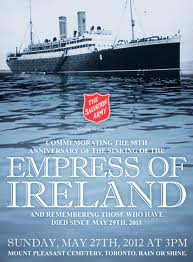
In 1971, David Brinnin, an American poet, literary critic and travel writer, dismissed the significance of the Empress of Ireland wreck. Brennin wrote that the dead were nothing better than “a lot of middle class Anglo-Saxons and a long roster of Salvation Army officers and executives from one end of Canada to the other.”
The Salvation Army was in fact devastated by the loss of many of its officers from Canada, and holds a memorial every year.
The Salvation Army was in fact devastated by the loss of many of its officers from Canada, and holds a memorial every year.
So in 1998, when maritime historian David Zeni published his book on the ship, he titled it The Forgotten Empress.
A few small tales have lived on. According to James Croall, writing in the 1978 book Fourteen Minutes, the ship’s cat, a yellow tabby “of doubtful antecedents”, fled down the gangway just as the ship was leaving. A steward ran after him and brought the cat back, but again the animal bolted and was left behind.
Efforts are underway to ensure that when the 100th anniversary of the sinking of the Empress of Ireland rolls around in 2014, Canadians will be more aware of this nationally important maritime disaster.
This story struck a small personal chord for me. Many years after this tragedy, I sailed to Canada as an immigrant aboard the CP’s Empress of England. We too left from Liverpool to Quebec City to begin a new life.
It also occurs to me this would be a great background story for a romance novel!
Anna Markland is the Canadian author of two medieval romance series, The Montbryce Legacy, and Sons of Rhodri. Book I of the Legacy, Conquering Passion, is still available for only 99 cents on Kindle.
Anna Markland is the Canadian author of two medieval romance series, The Montbryce Legacy, and Sons of Rhodri. Book I of the Legacy, Conquering Passion, is still available for only 99 cents on Kindle.
